FIELD NOTE · E0103
楹联怎样成为建筑上的一对可见文字?
How Does an Architectural Couplet Become a Visible Pair?
WORD BY WORD
进入逐词听读模式
顶部配图随进度轮播,未读文字为白色,读到后逐词变黄。
从成对载体、书写或雕刻、安装位置和可观察布局理解楹联。
THREE THINGS TO KNOW
- 01
楹联由上下两联组成;常见传统竖排从上到下书写,上联在右、下联在左。
- 02
楹联常见形式要求上下联字数相等、相应位置词性相当,并讲究平仄关系;整副联语字数并无统一固定长度。
- 03
楹联可写在纸上、装框,也可镌刻在竹、木、石等材料上。
BILINGUAL TRANSCRIPT
双语全文
-
A Chinese architectural couplet is not simply two sentences near a doorway.
中国建筑中的楹联,并不只是放在门边的两句话。
-
It is a matched pair of vertical texts whose position helps readers see how the two parts answer each other.
它是一对相互配合的竖排文字,所在位置能帮助读者看出两部分怎样彼此呼应。
-
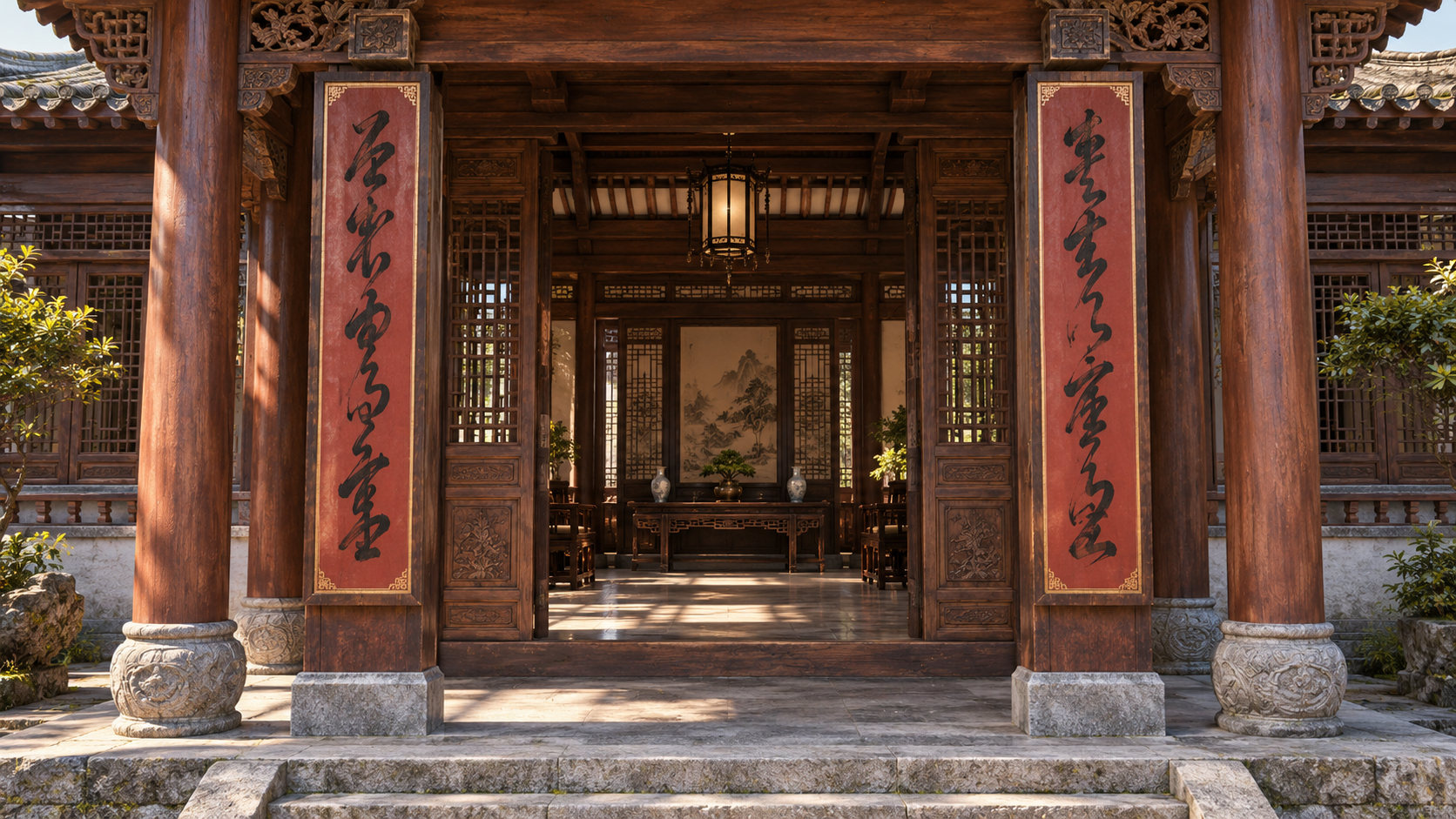
In the common traditional layout, the upper line is on the viewer's right and the lower line is on the left.
在常见的传统布局中,上联位于观看者右侧,下联位于左侧。
-
Both lines are commonly written and read from top to bottom.
两联通常都从上向下书写和阅读。
-
Paper provides a flat surface for displaying the two inked lines as a pair.
纸张提供了一个平面,让两行墨迹可以成对展示。
-
A writer uses brush, ink, paper, and inkstone to write one vertical line on each matching strip.
书写者使用笔、墨、纸、砚,在两张相配的纸条上各写一条竖联。
-
Equal character counts and related word roles help readers compare corresponding positions across the two strips.
相等的字数和相关的词性,能帮助读者比较两张纸条上的对应位置。
-
What matters is not perfect mirror symmetry, but a clear correspondence between the two sides.
重要的不是完全镜像对称,而是两侧有清楚的对应关系。
-
Traditional descriptions often expect equal character counts and related word roles, while the total length of a couplet can still vary.
传统说明通常要求两联字数相等、相应位置词性关联,但整副楹联的长短仍可变化。
-
A couplet may also be framed or carved in bamboo, wood, or stone.
楹联也可以装框,或刻在竹、木、石等材料上。
-
Carving changes the hard surface itself, so the words do not depend on a loose sheet of paper.
雕刻会直接改变硬质表面,因此文字不再依靠一张松散的纸。
-
On separate boards or panels, the upper and lower lines must remain in their intended order.
分写在两块联板上时,上联和下联仍要保持原定次序。
-
When they are fixed on matching pillars or two sides of an entrance, the architecture becomes part of the reading system.
当它们固定在相配的柱子或入口两侧时,建筑也成为阅读系统的一部分。
-
If the panels leave the same opening or their order is reversed, the pairing becomes harder to follow.
如果两块联板不再属于同一入口,或上下联次序颠倒,原定的配对关系就更难辨认。
-
You can inspect a displayed couplet without judging whether it is old or authentic.
你可以观察一副展示中的楹联,但不能只凭这些线索判断年代或真伪。
-
First, find two vertical pieces that belong to the same opening, hall, pavilion, or study.
第一步,找出属于同一入口、厅堂、亭阁或书斋的两件竖向载体。
-
Next, check the reading direction and identify which side begins the pair.
接着,检查阅读方向,并判断这一对文字从哪一侧开始。
-
Then compare character count, repeated sentence patterns, and related ideas across corresponding positions.
然后,比较相应位置的字数、重复句式和相关意思。
-
Finally, look for material clues: ink on paper, a frame around a panel, or characters shaped in a hard surface.
最后,寻找材料线索:纸上的墨迹、联板外的边框,或硬质表面形成的字形。
-
The same format serves more than Spring Festival decoration.
同一种成对形式并不只用于春节装饰。
-
Official heritage descriptions also record scenic, birthday, memorial, self-written, and trade couplets, as well as examples in many kinds of buildings.
官方非遗资料还记录了名胜联、寿联、挽联、自题联和行业联,以及多种建筑中的楹联。
-
Materials and colors are not one national rule: for example, spring couplets in the Forbidden City could use white paper rather than today's familiar red paper.
材料和颜色并非全国只有一种规则;例如,紫禁城里的春联可使用白纸,而不是今天人们熟悉的红纸。
-
This example shows why one doorway cannot represent every region, period, or purpose.
这个例子说明,一处门口不能代表所有地区、时代或用途。
-
Together, the words, materials, and architectural position make the two-part structure visible.
文字、材料和建筑位置共同让这种两部分结构变得可见。