FIELD NOTE · E0078
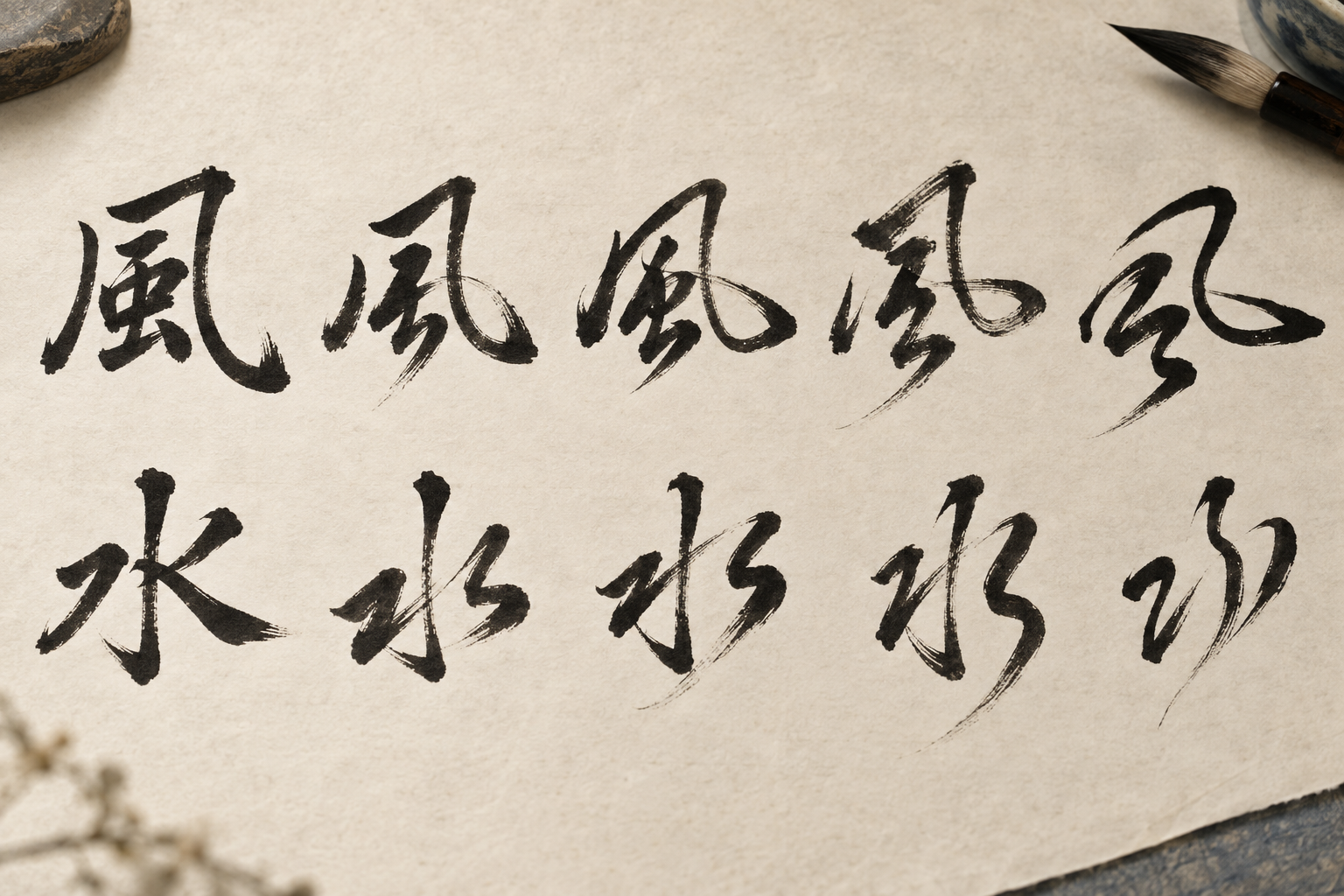
行书:在清晰与流动之间
Running Script: A System Between Clarity and Flow
WORD BY WORD
进入逐词听读模式
顶部配图随进度轮播,未读文字为白色,读到后逐词变黄。
THREE THINGS TO KNOW
- 01
行书是常见五体之一;传统概括‘非真非草、真草兼行’,说明它吸收较清楚的正体结构与较流动的草写因素。
- 02
行书常按正体成分与草写成分的多少描述为偏行楷或偏行草;这是相对的风格分区,具体作品可在两端之间连续变化。
- 03
行书通过笔画连带、适度省笔、转折连续及部分笔顺变化提高流动性,同时保留足够字形线索以便辨认。
BILINGUAL TRANSCRIPT
双语全文
-
Chinese running script is a writing system that balances clear character forms with connected, economical movement.
中国行书是一套在清楚字形与连贯、省简的书写之间取得平衡的系统。
-
An old phrase calls it neither regular nor cursive, but regular here does not simply mean modern kaishu.
古语说它既非正体,也非草书,但这里的正体不能简单理解为今天的楷书。
-
Running script is therefore more than regular script written faster.
因此,行书远不只是把楷书写得更快。
-
Writers may join strokes, omit parts, continue turns, or change some stroke order.
书写者可以连带笔画、适度省笔、让转折连续,或调整部分笔顺。
-
What matters is that enough clues remain for a trained reader to recognize the character.
关键在于,字形仍保留足够线索,让有一定训练的读者可以辨认。
-
When clearer forms lead, the style may be called xingkai, or running-regular script.
当较清楚的字形占主导时,这种风格可称为行楷。
-
With more cursive features, it moves toward xingcao, or running-cursive script, along a continuous range.
草写成分增多时,它会沿着连续范围趋近行草。
-
These names mark a spectrum rather than three boxes with fixed walls.
这些名称标示的是连续谱,而不是三只边界固定的盒子。
-
The system was forming in the late Eastern Han from existing clerical and cursive practices.
东汉晚期,行书已从既有的隶书、草书实践中逐渐形成。
-
Although later histories credit Liu Desheng, evidence does not support a sudden invention by one person.
后世书史虽归功于刘德升,但证据并不支持它由一人突然发明。
-
Excavated bamboo and silk texts reach the Wei and Jin periods, covering state records and private letters.
出土简帛实物延续到魏晋时期,涵盖国家记事和私人书信。
-
They show a changing world of everyday writing, yet we should not label every such object as mature running script.
它们展示了日常书写不断变化的环境,但我们不应把每件这类实物都定名为成熟行书。
-
A later account uses xingyashu for messages and letters, though this is not a modern scientific label.
后世记载使用“行押书”一词来指消息和书信往来,不过它并不是现代科学分类标签。
-
Rather than replacing every formal hand, running script offered a useful choice for some letters and handwritten documents.
行书并未取代所有正式书体,而是为部分书信和手写文书提供了一种实用选择。
-
The Lanting Xu, traditionally written by Wang Xizhi in 353, became a central model of running script.
相传王羲之于公元353年写下的《兰亭序》,成为行书的核心范例。
-
Wang's original is lost; the Palace Museum's Shenlong version is an ancient copy passed down since the Tang.
王羲之原迹已经不存;故宫所藏神龙本是自唐代流传下来的古摹本。
-
Its traditional link to copyist Feng Chengsu is uncertain, so it cannot be presented as the original.
它与摹写者冯承素的传统联系也并不确定,因此不能把它说成原作。
-
A Northern Song letter by Mi Fu carries a message to a friend while showing personal style.
北宋米芾的一封尺牍既向朋友传递消息,也呈现了个人风格。
-
In the Song, Su Shi, Huang Tingjian, Mi Fu, and Cai Xiang joined practical writing with individual expression.
宋代,苏轼、黄庭坚、米芾、蔡襄把实用书写与个人表达结合起来。
-
This was a later expansion of an older system, not the beginning of running script.
这是古老体系在后世的扩展,并不是行书的起点。
-
A printed xingkai typeface is repeatable page design, while a historical handwritten work records one act of writing.
印刷行楷字体是可重复使用的版面设计,而历史手迹则记录了一次具体书写行为。
-
Students may learn hard-pen running script, but it does not equal the full brush-and-ink system; adjusting clarity and flow still connects history with daily writing.
学生可以学习硬笔行书,但它并不等同于完整的毛笔笔墨体系;调节清晰与流动的行书至今仍连接着历史与日常书写。